

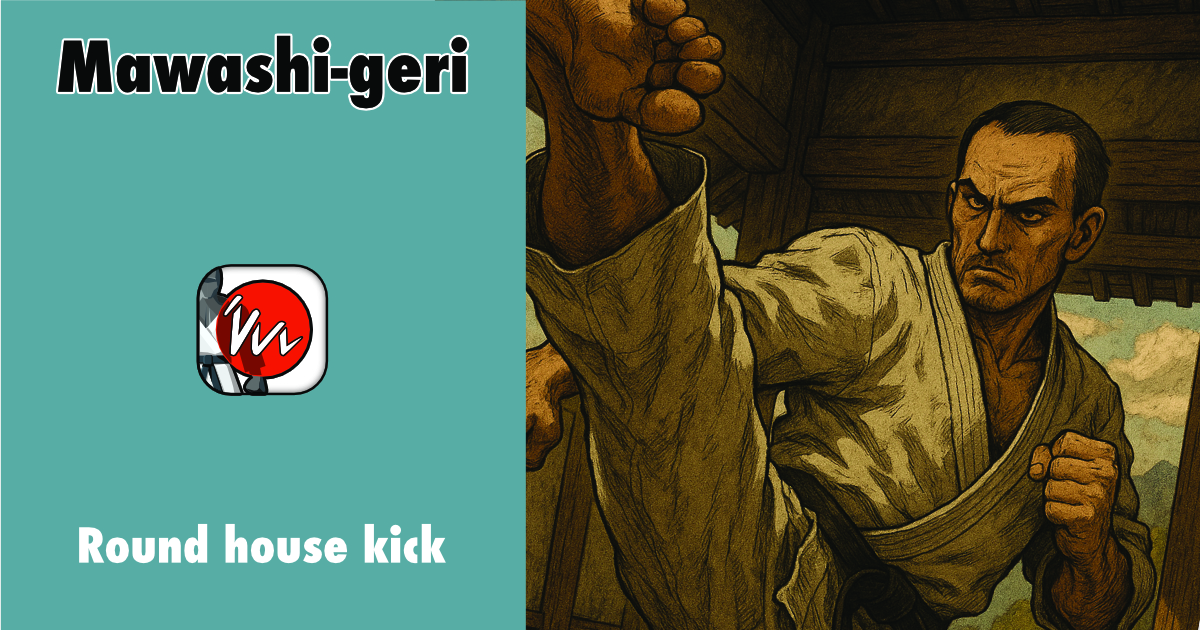
The mawashi-geri, or roundhouse kick, stands as one of Shotokan karate's most versatile and effective techniques. More than just a simple leg strike, it represents a synthesis of biomechanics, physics, and tactical awareness. Understanding its intricacies can transform this fundamental technique from a basic attack into a sophisticated tool of precision and power.
Foundation and Mechanics
The mawashi-geri begins from a fighting stance with the practitioner's weight firmly planted on the supporting leg. The technique unfolds in three distinct phases: chamber, execution, and recovery.
The Chamber Phase The kicking leg lifts with the knee bent and positioned strategically - this positioning choice determines both the power and tactical application of the kick. The thigh should reach parallel to the floor, creating a loaded spring ready to unleash its energy.
Power Generation and Execution The critical phase occurs during execution. The supporting foot pivots on its ball, allowing the hips to rotate explosively. This hip rotation serves as the primary engine of power, creating a kinetic chain that transfers energy from the ground through the supporting leg, into the rotating core, and finally into the striking limb.
The lower leg then extends rapidly from its chambered position in a whip-like motion. This extension snap generates significant acceleration, transforming the rotational energy into linear striking force.
Common Technical Errors Even experienced practitioners make subtle mistakes that dramatically reduce effectiveness:
- Guard hand dropping: Focus on the kick causes practitioners to drop their guard, creating openings for counter-attacks. Maintain strong hikite (pulling hand) position throughout.
- Inadequate pivot: Insufficient supporting foot rotation limits hip engagement and reduces power by 40-50%. Practice pivot drills separately to build confidence.
- Poor chamber height: Too low reduces power, too high compromises balance. Keep the thigh parallel to floor as the standard.
- Weak recovery: Many deliver the technique well but recover poorly. Train the complete cycle, emphasizing controlled return to fighting stance.
Physics of Impact and Target Selection
Not all strikes are created equal. The choice of contact surface dramatically affects the technique's effectiveness, and understanding target selection maximizes impact.
The Ball of the Foot (Koshi) When striking with the ball of the foot, practitioners concentrate substantial force into a small contact area. The physics principle is pressure concentration: Pressure = Force ÷ Area. By reducing contact area while maintaining force, pressure increases exponentially, creating a penetrating strike capable of significant effect with relatively less total force.
This technique demands precise foot formation - toes curl back safely while maintaining proper alignment. The shorter range forces closer engagement, making it ideal for:
- Floating ribs: Precise penetration can slip between ribs for internal impact
- Liver and kidney areas: Accessible from side angles, particularly effective against larger opponents
- Solar plexus: Disrupts breathing and balance when height and angle align correctly
The Instep Approach The instep offers a larger striking surface that distributes force over greater area. While reducing pressure concentration, it provides easier target acquisition, more forgiving execution, and excellent application for sweeping or off-balancing. The extended range proves valuable for:
- Thigh muscle: Damages opponent mobility without closing distance
- Hip joint: Disrupts stance and balance while maintaining safer range
- Lower torso: Broader target for reliable impact
- Common peroneal nerve: Side of thigh - can cause temporary leg dysfunction
Tactical Variations and Deception
Advanced practitioners understand that technique selection extends beyond mechanics to include psychological and tactical considerations. The mawashi-geri offers two distinct chambering approaches serving different strategic purposes.
The Traditional Side Chamber The conventional approach brings the knee up and out to the side early in the technique. This alignment allows maximum power generation since the entire kinetic chain optimizes for circular motion from the beginning. The hip rotation, pivot, and leg extension work in harmony to create substantial striking power.
However, this power comes with a cost: the technique becomes highly telegraphed. Any observant opponent can recognize the incoming roundhouse kick and prepare accordingly.
The Deceptive Center Chamber The alternative involves bringing the knee straight up through the centerline, identical to a front kick chamber. Only in the final execution phase does the technique convert to its circular path. This creates significant tactical advantage through misdirection - the opponent must guess whether to defend against a front kick or roundhouse kick until the last moment.
This deception trades some power for psychological advantage, since the technique doesn't utilize full hip rotation from the beginning.
Context Determines Choice
- Competition/Sparring: Deceptive chamber often proves superior against trained opponents who can read traditional chambers easily
- Self-Defense: Maximum power usually takes precedence since untrained attackers won't recognize the telegraph anyway
- Multiple opponents: Side chamber offers better transitional flow between targets
Range Dynamics and Distance Management
Understanding how striking surface and leg choice affect engagement distance provides crucial strategic advantages. This creates a tactical spectrum from close-quarters combat to maximum range engagement.
The Range Spectrum
- Closest Range: Lead leg with koshi - Maximum speed and precision for close-quarters combat
- Medium-Close Range: Lead leg with instep - Quick strikes with moderate reach
- Medium-Long Range: Rear leg with koshi - Power delivery at moderate distance
- Maximum Range: Rear leg with instep - Full power and reach extension
Lead Leg Advantages Significantly faster execution, reduced telegraphing, excellent for quick counters and intercepting attacks, superior for combination work. However, sacrifices both range and power compared to rear leg techniques.
Rear Leg Advantages Maximum range extension, greater power generation through extended kinetic chain development, more time to build rotational momentum. The trade-off involves increased execution time and greater telegraphing.
Distance Management (Ma-ai) In Shotokan, ma-ai represents proper combat distance - not just physical spacing, but the dynamic relationship between opponents that creates opportunity. Key principles include:
- Creating distance: Use footwork to establish preferred range before committing to technique
- Reading cues: Opponent's weight distribution reveals available reaction options; foot positioning indicates likely defensive choices
- Timing strategies: Irimi (entering) to jam opponent techniques, tai-no-sen (intercepting) to meet their advance, or go-no-sen (after-the-fact) counter-attacking
Training Methodology and Application
Developing mastery requires progressive training that builds from foundation to unconscious competence - the ability to select and execute optimal technique variations without conscious thought.
Stage One: Foundation Building Focus on perfect form with static targets: technical precision through slow deliberate movements, power development via explosive hip rotation, contact conditioning for both koshi and instep strikes, and balance mastery of pivot mechanics.
Stage Two: Dynamic Integration
Introduce movement and combination work: practice against moving targets, integrate with hand techniques and other kicks, develop reactive training responding to called targets, and practice smooth transitions between range/power variations.
Stage Three: Combat Application Emphasize real-time decision making under pressure: apply techniques during free-sparring, practice multiple opponent scenarios and escape angles, train in various environments with obstacles, and maintain technique quality under physical and mental stress.
Physical Conditioning Requirements Master-level execution demands specific preparation: hip flexor mobility for high chambers, hamstring flexibility for proper extension, ankle mobility for koshi formation, supporting leg stability to prevent wobbling, and core rotation power for explosive hip drive.
Integration with Karate Principles The mawashi-geri embodies core Shotokan concepts: ikken hissatsu (one strike, certain death) through complete commitment to each technique, zanshin (continued awareness) maintaining readiness throughout the technique cycle, and kata application revealing traditional target preferences and timing through bunkai study.
Advanced Applications and Troubleshooting
Even well-executed techniques can encounter problems. Advanced practitioners develop contingency responses and create opportunities rather than simply waiting for them.
When Things Go Wrong
- Technique caught or blocked: Convert to sweep, use trapped leg as pivot for spinning techniques, or transition to close-range grappling
- Distance miscalculation: Too close - convert to knee strike; too far - step through or chain follow-up techniques; wrong height - adjust target mid-technique
- Balance loss: Use momentum to recover through forward movement, step back with kicking leg, or spin into new positions
Creating Opportunities Advanced practitioners actively create openings through level mixing (high kicks to draw guard up, then attack low), rhythm manipulation (establish patterns then break them), false telegraphs (show one chamber type, switch to another), and opponent conditioning (establish specific responses to exploit later).
Environmental Adaptations Real situations demand flexibility: modify for different footwear affecting pivot mechanics, adapt to terrain variables like stairs or slopes, adjust for confined spaces with low ceilings or narrow areas, and select appropriate range for multiple opponent scenarios.
Conclusion: The Path to Mastery
The mawashi-geri represents far more than a simple kick - it embodies the sophisticated interplay between physics, biomechanics, psychology, and strategy that defines authentic martial arts training. From pressure dynamics of contact surfaces to tactical implications of chamber choices, every aspect serves both mechanical and strategic purposes.
True mastery emerges not from perfecting a single approach, but from understanding all variations and developing unconscious competence to select appropriately in real-time. This represents the difference between learning techniques and embodying martial arts.
Through thousands of repetitions, conscious choices become internalized patterns. The body learns to recognize subtle environmental and tactical cues below the threshold of conscious awareness, allowing for much faster response times. At the highest levels, technique selection transcends conscious decision-making entirely - appropriate techniques emerge naturally from the situation without mental interference.
Whether drilling in the dojo or facing real confrontation, the mawashi-geri stands ready to serve. The roundhouse kick remains fundamental precisely because it contains multitudes: power and finesse, tradition and adaptation, conscious knowledge and unconscious wisdom. The technique becomes not what we do, but who we are - trained, adaptive, and ready.